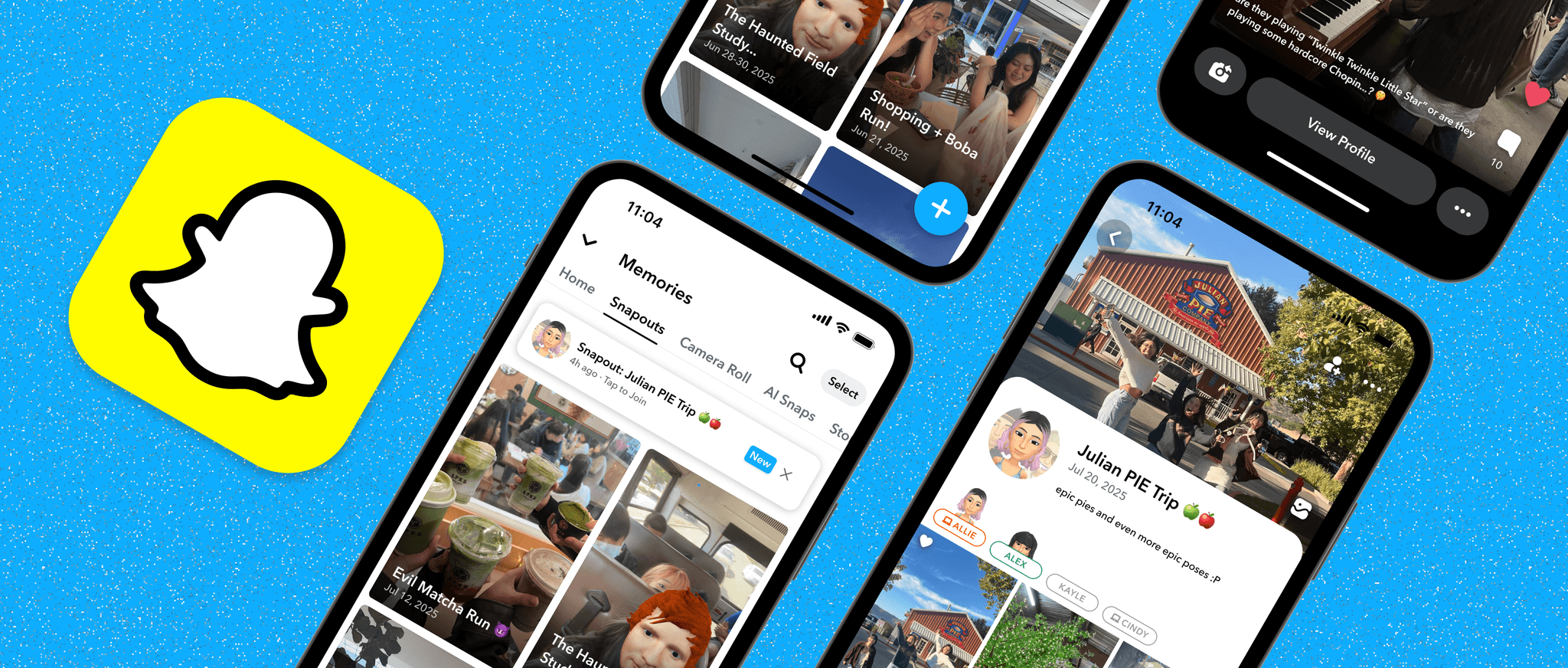
INTERN PROJECT
Snapouts
Connecting Friends Through Shared Snapchat Memories.
Overview
This was a solo product design concept completed over a week during my internship at Snapchat, aimed at enhancing collective memory sharing among friend groups.
The project involved end-to-end UX/UI design, from user research and conceptualization to high-fidelity prototyping. The final concept was presented and received direct feedback from Snapchat’s core product team, demonstrating its viability and alignment with Snapchat's mission to facilitate real-time communication and self-expression.
Company
Snap Inc.
Role
Product Designer
UX Researcher
Skills
Prototyping
Visual Design
Usability Testing
Timeline
1 week
August 2025
THE PROBLEM
The Unshared Experience of Group Snaps
While friend groups frequently capture shared moments on Snapchat, these collective memories become fragmented across individual users' private "Memories" and often remain inaccessible or forgotten by the group as a whole.
“How can I leverage social context to design a collaborative space that automatically collects and intelligently organizes Snaps taken during a shared group experience?"
EARLY INSIGHTS
User Survey Results
To validate the severity of the unshared experience and identify the core needs of Snapchat's user base, I conducted a mix of quantitative user surveys and qualitative interviews with active Snapchat users (ages 16–25) who frequently use group chats and the camera.
Here are the insights gathered:
The Screenshot Scramble
78% of users reported a manual process of screenshotting or re-sending Snaps taken together.
Significant friction in flow of collecting and group-captured snaps.
This validated the need for a seamless, automated collection system.
Low Memory Retrieval
When asked to find a specific group photo taken over a month ago, only 15% were able to locate it easily using individual search.
More Value on Shared Context
85% of participants reported that group memories lose value when owned individually, and prefer collective ownership.
Memory value on Snapchat is fundamentally social, not just archival.
Must prioritize collective ownership and shared nostalgia.
DESIGN PROCESS
User Experience Flows
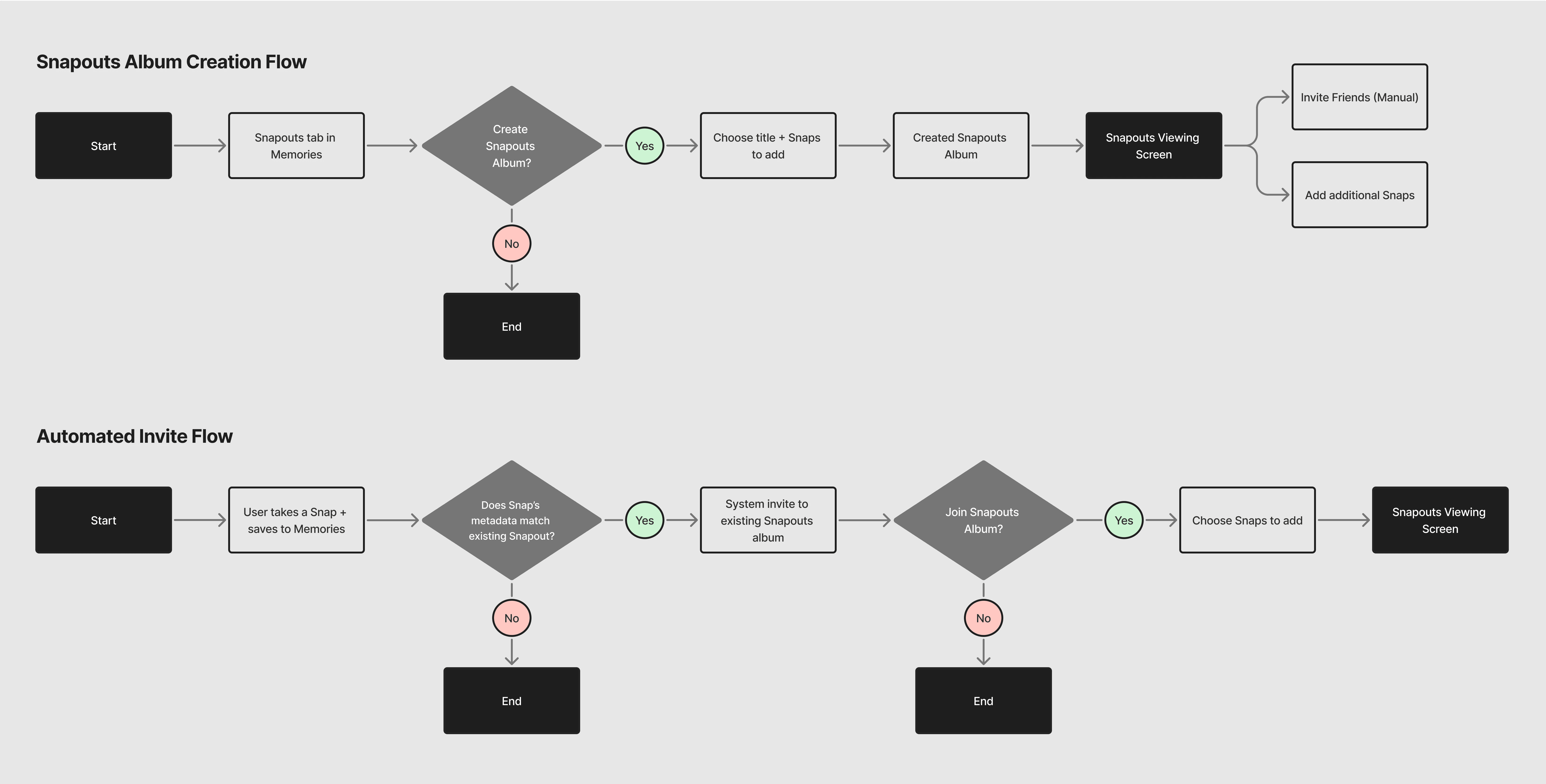
The primary challenge was designing a feature that reduces as much friction in the memory collection process as possible. This was achieved by architecting the solution around two core principles:
Centralized Access
Implementing a new organizational tab for group albums (Snapouts) within the existing "Memories" page, solving the retrieval problem.
Seamless Contribution
Leveraging Snap metadata (time, geolocation, and friend activity overlap) for automatic, low-friction Snap collection & friend invites into the relevant album.
Early Concepts & Prototypes
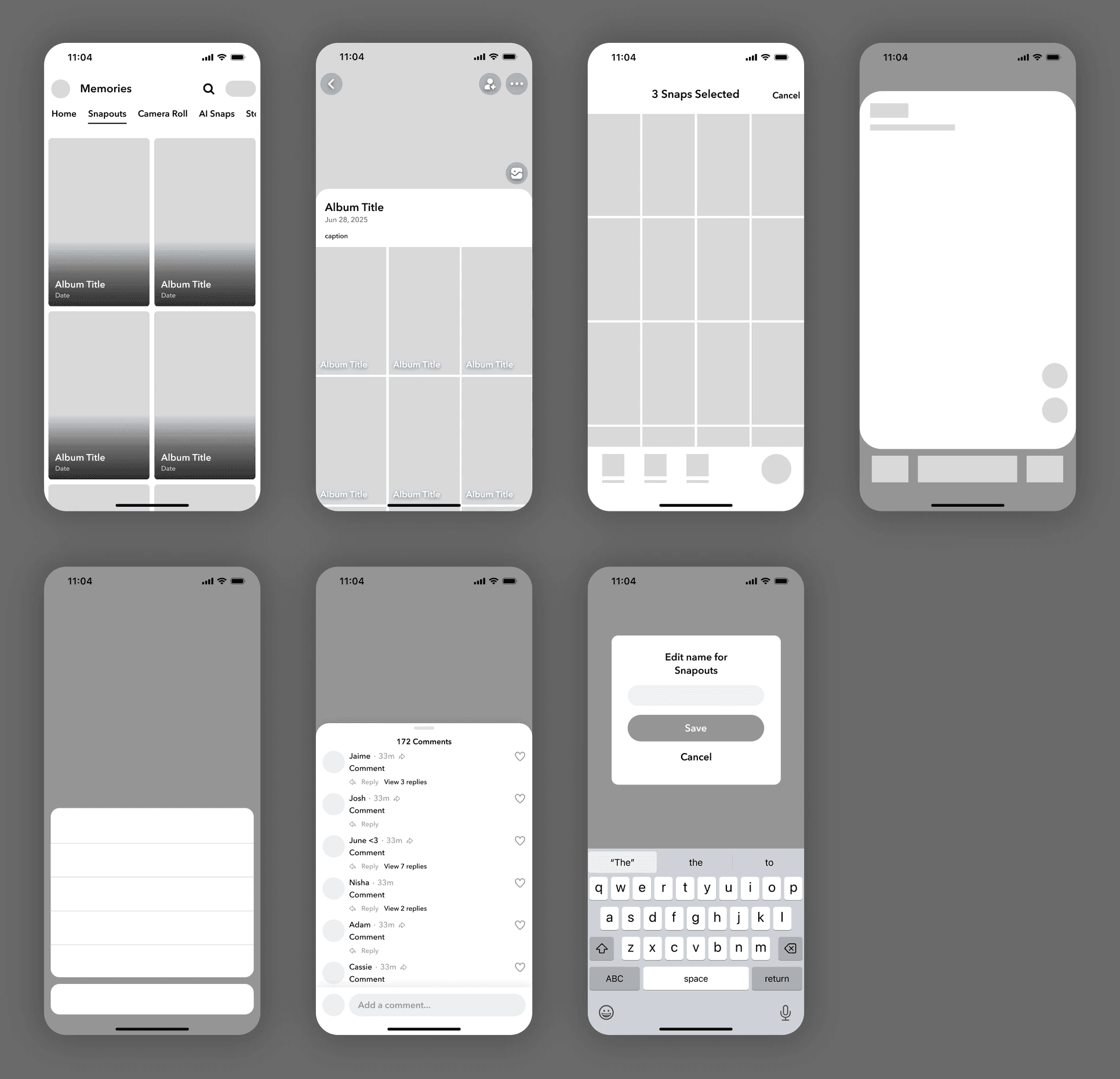
The low-fidelity stage focused on the spatial placement of Snapouts within the existing Snapchat experience and ensuring the new event-based organization was intuitive for users.
Entry Point: Integration of the feature into the Memories pivot for a general low-friction entry point
Organizing by Event: Solving the problem of scattered moments and collection friction by organizing albums by group context and event, not just by date
Collaborative Viewing: Designing album viewing to feel collaborative and encourage contribution and interaction

THE SOLUTION
The Snapouts Experience
The final high-fidelity design integrates the feature into the Snapchat ecosystem to represent the functionality of Snapouts, including the core flows of low-friction entry and collaborative album viewing.

Integrated Entry Point
The design focus was to maintain the "snappy" and clean look of Snapchat by adding Snapouts as part of the Memories pivot, with albums visually organized by context rather than date.
Users can accept the automated, event-based invite into the Snapouts album for an easy experience viewing group memories.

Viewing a Collaborative Album
The viewing experience was designed to feel distinct from individual user memories, using clear visual cues to highlight user contributions.
Snaps within the album prominently feature the contributor's Bitmoji and name, and comments facilitate collective interaction.
REFLECTIONS
Key Takeaways
Embracing System Constraints: The biggest learning was prioritizing seamless integration over designing a completely new, disruptive feature. The initial concept involved creating an entirely separate "Snapouts" entry point, but feedback and platform constraints led to the final decision to integrate it iwithin the existing Memories pivot, ensuring low friction and intuitive discoverability.
Next Steps for the Future
Explore cross-contextual linking by integrating Snapouts into Group Chats, providing instant access to memories related to that specific group thread, and streamlining Snap retrieval even further.
Usability testing focused on proving that the solution eliminates user pain points:
To measure clarity of Snap retrieval, users are asked to locate specific, older group memories using the Snapouts hub, compared to using the existing individual Memories search.
To measure friction of manually adding external media, users are asked to add photos or videos from their camera roll of the event, measuring ease of use to ensure the process remains intuitive and quick, even for content the initial design excluded.